“How Can You Not See What I’m Seeing?”
Two people can know the same numbers and still see a completely different financial picture.
There is something I've noticed with couples that used to surprise me.
Sometimes one person knows the numbers and the other really doesn’t. One is tracking the accounts, thinking about what’s coming, worrying about whether things are working, while the other mostly trusts that it’s being handled.
That’s what I used to think of when I heard the phrase uneven financial awareness.
But now I know it can be much more subtle than that.
Sometimes both people know the numbers. They're both engaged, and they care, but they can still see something very different.
Some define income differently. They may have different ideas about what money is actually available to spend. One may be focused on what’s happening month to month while the other is thinking years ahead. One may see risk where the other sees plenty of room.
Oh my. And then the frustration starts.
One partner feels worried, unsupported, or like they’re carrying responsibility for something their partner doesn’t take seriously. The other feels criticized, controlled, or confused by the intensity of the concern. And here's the thing: neither one thinks they’re ignoring reality, and each one thinks they're right.
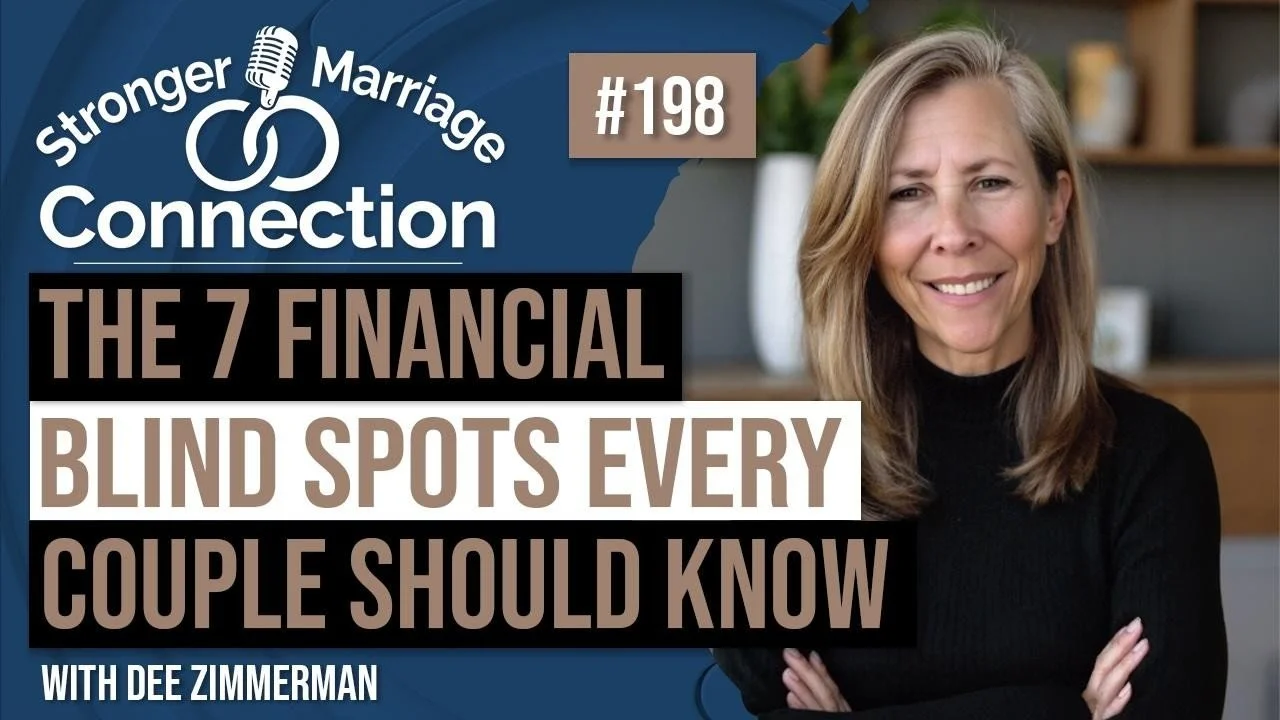
That’s one of the dynamics I talked about in my return visit to the Stronger Marriage Connection podcast with Dave Schramm and Liz Hale. The episode is called The 7 Financial Blind Spots Every Couple Should Know, and this one stands out to me because I see some version of it so often.
You may have noticed that the last few weeks I've been talking about building wealth. But all of that gets a lot harder when two people are seeing things differently. That's why I think noticing this kind of uneven financial awareness matters so much.
If the story becomes you need to relax or you need to start paying attention, it usually just creates more defensiveness and resentment. But if you can stop and ask, Are we actually seeing this the same way?, you have something to work with.
That doesn’t mean one of you is right and the other is wrong. It could mean there’s information one person has that the other doesn’t, or you may simply be using different assumptions. And fear might be influencing what each of you notices.
That’s really what these blind spots are about. They’re patterns underneath the stress that can be easy to miss because we tend to focus on the obvious thing: the spending, the account balance, the argument we just had, the decision we can’t seem to make.
In the episode, Dave, Liz and I talk through seven of these patterns, including lack of shared financial direction, money conversations that go nowhere, hidden financial stress, different comfort levels with spending, systems that developed without collaboration, and uncertainty about the future.
If any of this sounds familiar, I’d love for you to listen to the conversation.
My hope is not that you come away thinking, Great, another thing we’re doing wrong. It’s that you notice something you hadn’t been able to name before and think, Oh. Maybe that’s what’s going on here.
That awareness can give you somewhere to begin.
Dee